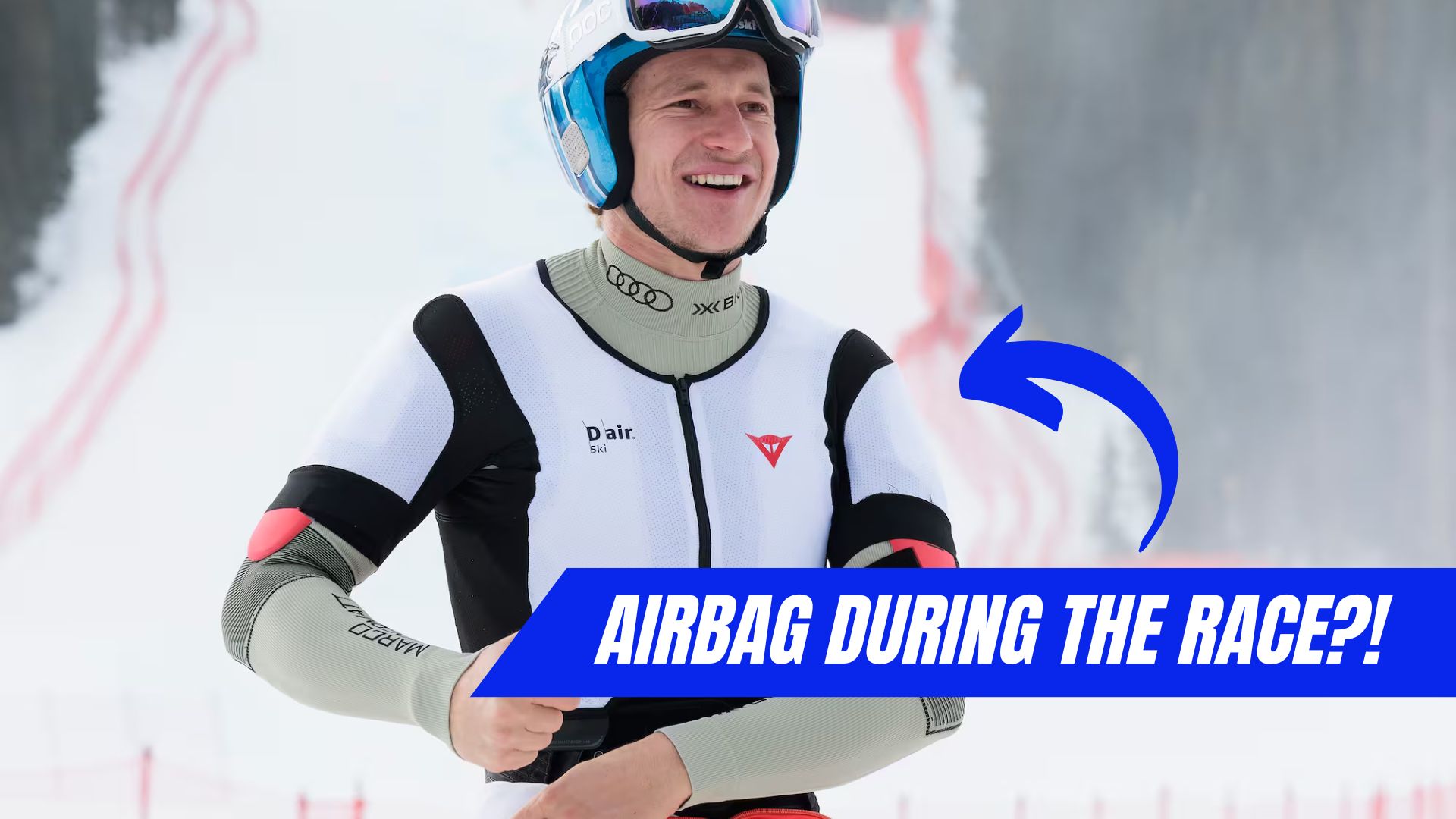
The new rule about compulsory airbags brings controversies. And no, we are not talking about the car industry; we are still in the alpine skiing area. In November 2024, FIS declared that wearing the so-called airbag, the high-tech suit D-air by the Italian company Dainese will be compulsory in super-G and downhill events. The system functions just like the airbag in the car, as it inflates automatically in case of a crash, preventing further injuries to the torso. Some athletes wear it already, like the speed queen Sofia Goggia (ITA) or Marco Odermatt (SUI) with his colleague Niels Hintermann.
There is still much discussion around the suit’s use. While some athletes regard it as an unnecessary nuisance that can cause further complications, some downright refuse it as counterproductive.
Why Use the Airbag?
The final straw that broke the back of FIS’ patience was the death of an Italian skier, Matilde Lorenzi, who crashed during training. Further incentive came from the epidemic of serious injuries that plagued last season. However, most of them were knee or other joint injuries.
Some athletes have used the airbag without complications for years. Marco Odermatt’s freedom to move is surely not hindered by the suit.

Sofia Goggia won many times wearing the airbag and also tested it by fire in high-speed crashes. The D-air system definitely adds security to the upper body. It protects the athletes from bruises, adding to the safety provided by the spine protector.

The Critical Voices
Anything declared compulsory awakens criticism, as people like to decide for themselves. Lara Gut-Behrami, for example, stated that until she sees the proof of the safety of the airbag, she will not use one.
There are serious concerns about the suit. Austria’s downhill and super-G skier Mathias Mayer crashed in Val Gardena in 2015 wearing an airbag. Even though the video from this horrible crash is widely used to promote the suit, saying that it saved Mayer’s life, we need to add that he still broke two thoracic vertebrae. Speculations rose, whether the airbag helped or even if the construction did not cause the injury.

Next came the incident with Thomas Dressen, who dislocated both his shoulders in a crash in 2020. Some voices declared that the activation of the airbag at high speed caused this specific injury. Suspicion rose so high that after witnessing his teammate’s crash, Romen Baumann stopped wearing the airbag after seven years of use.

Another criticism concerns legal issues, saying that nobody knows who will be responsible for the airbag activation at an unwanted moment, which would indeed cause a horrible crash. Furthermore, most injuries in alpine sports are knee injuries, and no airbag can protect the athletes against that.
The Loophole
As the athletes complained about the movement limitations (Vincent Kriechmayr) or the brutal deadline for getting used to wearing the airbag (Norwegian downhillers), they found a loophole. FIS said that exceptions would be granted to athletes who can prove that they are medically unfit to wear the airbag or when their movement is seriously restricted.
Until today, 40 athletes have been granted the exception, 16 from Austria. Now, nobody is happy. Athletes who comply with the new rule but are unhappy about it feel disadvantaged. They will surely complain if an athlete without the airbag will beat them in the race. Athletes with airbags who do not trust them are given just another thing to worry about, and athletes who refuse to wear them will feel under pressure as the controversy goes on.
In the meantime, FIS discusses new “exciting” measures like racing in Argentina, clearly wondering how to make the race calendar even more demanding. FIS proclaimed that they are all about the safety of the athletes. Still, we all understand that more time for regeneration and less traveling would bring more safety to the races than any suit or armor.
Let us all hope the D-air system works as the manufacturer says. Furthermore, let us hope for as few activated airbags during the races as possible.